Idrija
Year 1492: Columbus discovers America; Reconquista is finished; Lorenzo
de'Medici dies in Florence. In a remote part of the then Venetian
terra ferma, situated right near the borders of the Adriatic Sea and
Black Sea water drainage basins, and of the Karst and subalpine regions,
free mercury has just been discovered in a stream. Colonization begins;
a new town spawns in a narrow valley, its name derived from
Hydrargirum, Latin for mercury. The mine is to become the world's
second largest, after Almaden, Spain.
The New Idria settlement at a mercury mine in
California, USA, is named after Idrija.
The region was volatile. Venice had to yield it to Austria in 1509.
As of 1575 the mine was directly subject to the Austrian Emperor;
consequently, most documents are nowadays to be found in the
Hofkammerarchiv in Vienna. From 1797 to 1813 the region was occupied by the
French and was part of the "Illyrian provinces". Between WWI and WWII,
western Slovenia including Idrija was part of Italy.
A complicated geological fault system necessitated digging of deep
pits (up to 400 meters), and fighting large quantities of
intruding water. This made Idrija a center of technological
innovation for centuries, attracting many famous people from Austria
and other countries, and an important part of the scientific endeavor
in Slovenia throughout its history.
After 500 years of operation, and after having produced 107,000
tons, or 13 percent of the world production of mercury, the mine
has been gradually closed in 1980s
due to low mercury prices and ore exhaustion. Idrija's
industry managed to shift rather painlessly to being one of the
largest world producers of small electric motors and their components.
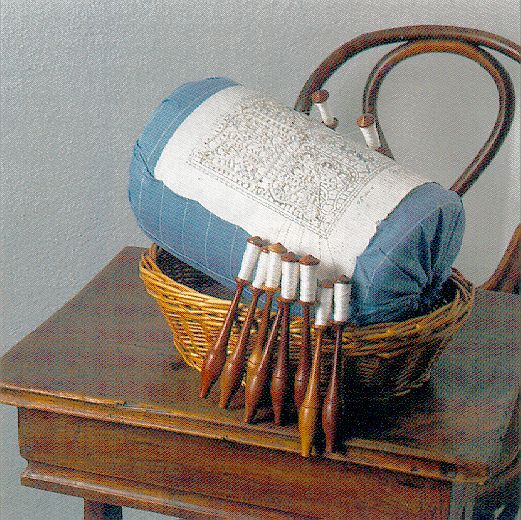
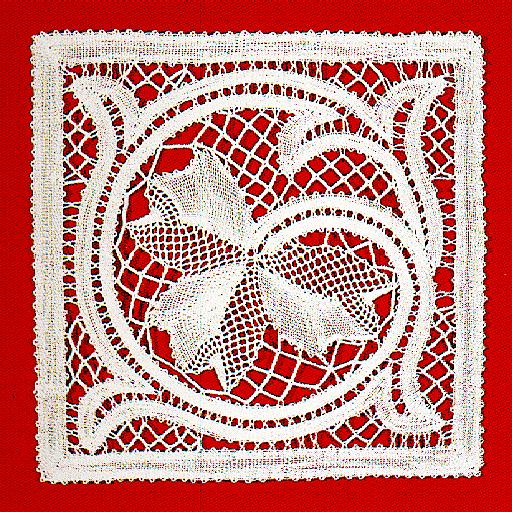
The
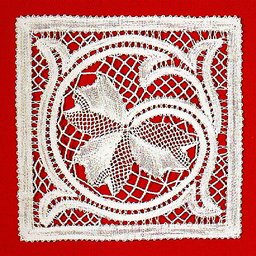 lace is part of local tradition,
and widely recognized. The craft was brought there a couple
of hundred years ago by Czech or German families working in the mine
or its headquarters. Basically, it was an appropriate activity
in a culture not dependent on agriculture for survival. The Idrija
lace is now registered as a trademark, and care is being taken to
preserve the craft itself. The Idrija lace proper appeared in the
1870s and was made using 7 pairs of
bobbins.
lace is part of local tradition,
and widely recognized. The craft was brought there a couple
of hundred years ago by Czech or German families working in the mine
or its headquarters. Basically, it was an appropriate activity
in a culture not dependent on agriculture for survival. The Idrija
lace is now registered as a trademark, and care is being taken to
preserve the craft itself. The Idrija lace proper appeared in the
1870s and was made using 7 pairs of
bobbins.
Idrija's coat of arms features a figure of the god Mercury modeled after
a statue attributed to de Vries, c. 1610, and possibly to G. Bologna,
and whose copy can be seen, for example, in the Rotunda of the National
Gallery in Washington.
Idrija has been listed on the
UNESCO World Heritage List
since 2012.
Mercury in Idrija comes in two guises: as cinnabar (mercury sulphide,
HgS) rock inclusions, and as pure mercury, referred to as 'native'
mercury.
In the beginning, ore was smelted in ceramic pots in the surrounding
hills (in a kind of charcoal-making piles) because this was easier than
transporting large quantities of wood to Idrija. But then too much mercury got
smuggled out ...
Mercury was first exported via Venice to Levante, and later also to
Germany and Holland, to be further exported to Mexico and Peru for use
in amalgamation in silver and gold mines there. Since 1659 Amsterdam
was the main export center. In 1785-1797, up to 700 tons of mercury
were exported to Spain yearly.
A castle (now housing the
Museum)
was erected
between 1522 and 1533
to protect mercury against possible attacks
by the Turks who advanced to Europe at that time.
The world use of mercury peaked around 1968. According to the 1968 US
data, of the total of 2500 tons, 600 tons were used in chlorine and
caustic soda production, 600 tons ended up in batteries and light bulbs,
380 tons in control instrumentation, 360 tons as color additives, 141
tons in people's teeth, 120 tons in agricultural fungicides, 13 tons
were used in paper and cellulose industry, etc. Cinnabar was a well
known dye; mercury chloride has still been used as antiseptic even in this century.
The mining operation was a textbook case of full utilization of the wood
and water resources in the river Idrijca basin, without actually
destroying either, except very close to the smelting operation.
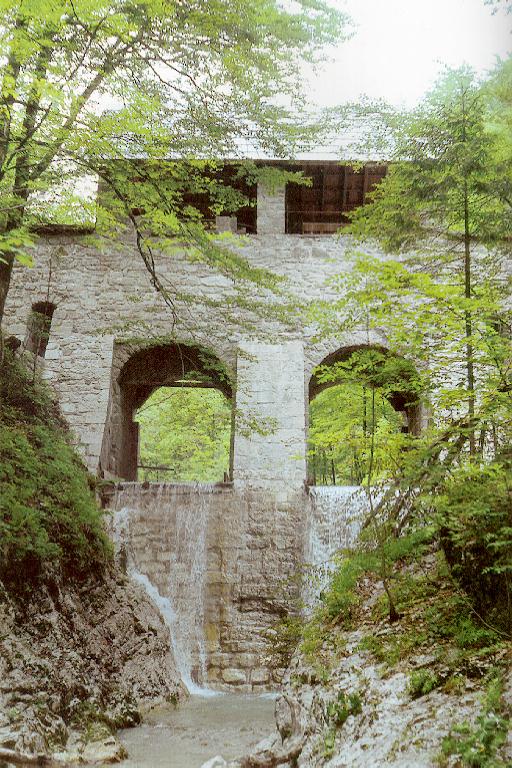
Several water dams, initially made of wood, for floating timber by water
were built in remote valleys
called Klavže (from Latin "claustra", barriers). Starting in 1767,
the local engineer Jozef Mrak finished the first stone
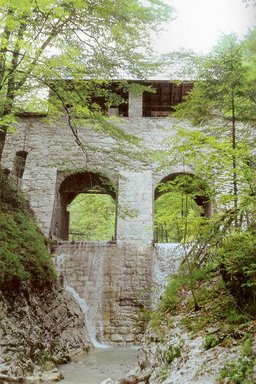 Klavže in the
Belca valley (1769) and in the Idrijca valley (1772), and repaired some
others. Klavže had wooden doors that a special mechanism
flung open quickly to produce a rushing
wave that flushed the stacked timber
along the valley towards Idrija.
Timber was collected in the town by rows of wooden stakes spanning the river,
the first of these having been constructed in 1531.
Klavže in the
Belca valley (1769) and in the Idrijca valley (1772), and repaired some
others. Klavže had wooden doors that a special mechanism
flung open quickly to produce a rushing
wave that flushed the stacked timber
along the valley towards Idrija.
Timber was collected in the town by rows of wooden stakes spanning the river,
the first of these having been constructed in 1531.
The mine water was drained by water-driven pumps, popularly called
Kamšt (from German "Kunst", art).
Restored in 1994 is
the largest still existing water wheel in Europe: 13.3 meters in diameter,
built around 1790,
driven by water from the Idrijca river,
it had been pumping
water from a depth of 270 meters, without interruption, for 160
years, until 1948, after the WWII! In 1665, the English astronomer
and poet
Walter Pope wrote he had never seen water wheels as large as those used
in Idrija.
In the 16th century, Paracelsus visited Idrija and introduced
mercury to
medicine. Joannes Antonius Scopoli served as medical doctor in Idrija
from 1745 to 1769. (1761 is the year of the first lace and of the work
by Scopoli:
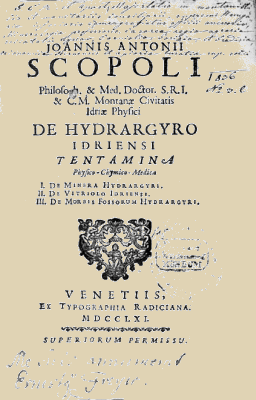 De Hydrargyro Idriensi.)
Balthasar Hacquet, who also wrote
the Oryctographia Carniolica and
corresponded
with Carl Linnaeus,
lived in Idrija from 1766 to 1773;
at that time, Idrija was the second largest town in Carniola.
De Hydrargyro Idriensi.)
Balthasar Hacquet, who also wrote
the Oryctographia Carniolica and
corresponded
with Carl Linnaeus,
lived in Idrija from 1766 to 1773;
at that time, Idrija was the second largest town in Carniola.
The so called riddle of the Idrija ore deposit (its origin and structure) was
fully solved only after WWII by dr. Ivan Mlakar, who in doing so established
the internationally recognized Idrija geological school.
One can visit all the following in the order listed, starting from above the town center.
The Church of the Holy Trinity, on the spot where, according to
legend, mercury was first discovered by a cooper ("škafar" in local
tradition) in a stream.
Right below, on the main square, is the Town hall (1898); a short walk to the right
leads to the first non-classical
secondary school in Slovenia ("realka", 1901).
The Gewerkenegg castle
houses the Idrija Music School and the
Idrija Municipal Museum.
It includes memorial rooms of the writer France Bevk and the politician
Dr. Aleš Bebler (among other things, a letter from Mr. Dulles is displayed).
There is a permanent exhibition of about a hundred works of art donated by
Mrs. Mazza, a native of Idrija and owner of an art gallery in Rome, Italy.
The old town square is dominated by the Old Wheat Storage ("Magazin"), now housing
a public library and gallery, next to Slovenia's first
theater house, the Forestry Administration building, and the former
presbytery.
Anthony's shaft
(1500) is the second oldest preserved mine entrance in Europe (one
enters the mostly level mine gallery through a building with a chapel).
At the other side of the town, the first landmark is the building housing
the water wheel driving the Kamšt.
A tranquil walk above the Idrijca river, in the shade along the so called "Rake"
(from German "Rinne", an open water channel),
built in 1596 for driving the Kamšt water wheel, and nowadays, after 4 centuries,
still supplying water to a nearby electrical power plant, brings one to the
river dam feeding the "Rake" canal,
and then across the river to "Divje jezero" (Wild Lake),
a siphon-driven (86 meters deep) little lake half enclosed by 200 meters
high vertical cliffs.
Bela, a small settlement about 8 km upstream of Idrija, is a jewel of almost unspoiled
nature, featuring a swimming and picnicking place at the confluence of the Idrijca
and Belca rivers. In the summer, a removable dam creates a pool with water a bit warmer
than the input stream.
More upstream the valley splits in Belca and Idrijca valleys, where old, winding
Italian military roads bring one to Klavže ("Slovenian pyramids").
From the Klavže on Belca one can proceed
to Vojsko, the highest-lying village in Slovenia. From the Vojsko Plain,
one can descend into a remote valley with the WWII Slovenija
printing office (with equipment smuggled from Milan, Italy,
during the war), which printed "Partizanski dnevnik" (Partisan Daily),
the only newspaper published by Resistance movements in Europe.
(The place was chosen by my grand-grand father.)
A Lace-makers' Festival is held in Idrija in summer.
The main event in the festival is a competition usually entered by a
couple of hundred women (no age limit), and even a few men.
Several restaurants, for example the Pri Škafarju
(At the Tub-maker's) inn serve the traditional miners' food,
žlikrofi (potato balls with marjoram and other spices, wrapped in
thin dough, and boiled).
The Municipal Museum
is open 9 am to 7 pm every day; phone: +386 5 3726 600. Visits to the mine
as well as other points of interest can be arranged through the Museum.
(C) 2000-2026 Rajmund Krivec
Version 4 (2026). From various sources, with thanks to Darko Viler.
 lace is part of local tradition,
and widely recognized. The craft was brought there a couple
of hundred years ago by Czech or German families working in the mine
or its headquarters. Basically, it was an appropriate activity
in a culture not dependent on agriculture for survival. The Idrija
lace is now registered as a trademark, and care is being taken to
preserve the craft itself. The Idrija lace proper appeared in the
1870s and was made using 7 pairs of
bobbins.
lace is part of local tradition,
and widely recognized. The craft was brought there a couple
of hundred years ago by Czech or German families working in the mine
or its headquarters. Basically, it was an appropriate activity
in a culture not dependent on agriculture for survival. The Idrija
lace is now registered as a trademark, and care is being taken to
preserve the craft itself. The Idrija lace proper appeared in the
1870s and was made using 7 pairs of
bobbins.
 Klavže in the
Belca valley
Klavže in the
Belca valley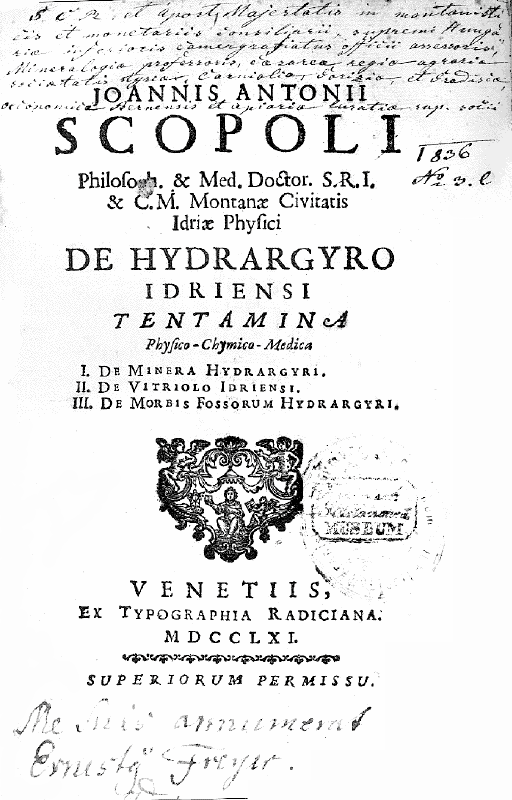 De Hydrargyro Idriensi