More research highlights

Institut "Jožef Stefan", Jamova 39, 1000 Ljubljana, Slovenija, Telefon: (01) 477 39 00, Faks.: (01) 251 93 85
info@ijs.si


Using dilatometry and small-angle x-ray diffraction we have studied, under bulk conditions, the structural changes and elastic response of dioleoyl phosphatidylcholine bilayers to alamethicin. With increasing peptide concentration, we found a progressive thinning of the membrane. However, in contrast to previously published reports, this thinning follows an exponential behavior. 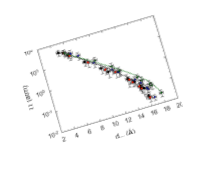 Furthermore, an increase in alamethicin content resulted in an increased lateral area per lipid and a swelling of the multibilayers, which can be attributed to a decrease in the bilayer’s bending rigidity by ~ 50 %. At the same time, hydration and van der Waals forces remained unaffected by the presence of the peptide. Interestingly, all elastic and structural parameters followed the same exponential form found for the membrane thickness, implying a common underlying mechanism for all of these structural parameters. As a result, we have been able to reconcile recent controversies regarding the effect of peptides on membrane thinning.
We develop a boundary element method to calculate Van der Waals interactions for systems composed of domains of spatially constant dielectric response of a general boundary shape. We achieve this by rewriting the interaction energy expression presented in Phys. Rev. B, 62 (2000) 6997 exclusively in terms of surface integrals of surface operators. We validate this approach in the Lifshitz case and give numerical results for the interaction of two spheres as well 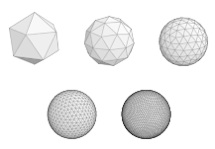
as the van der Waals self-interaction of a uniaxial ellipsoid. Our method is simple to implement and is particularly suitable for a full, non-perturbative numerical evaluation of non-retarded van der Waals interactions between ob jects of a completely general shape.
We study the effect of dielectric inhomogeneities on the interaction between two planparallel charged surfaces with oppositely charged mobile charges in between. The dielectric constant between the surfaces is assumed to be different from the dielectric constant of the two semi-infinite regions bounded by the surfaces, giving rise to electrostatic image interactions. 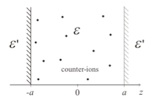 We show that on the weak coupling level the image charge effects are generally small, making their mark only in the second order fluctuation term. However, in the strong coupling limit, the image effects are large and fundamental. They modify the interactions between the two surfaces in an essential way. Our calculations are particularly useful in the regime of parameters where computer simulations would be difficult and extremely time consuming due to the complicated nature of the long range image potentials.