We present a phenomenological one-parameter scaling equation of state that accurately represents osmotic pressures
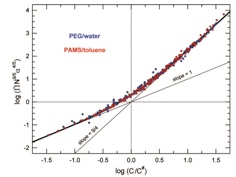
of neutral flexible polymers in good solvents from the dilute through the semidilute regime. The equation comprises

a sum of scaled van’t Hoff and des Cloizeaux terms including a fitted parameter R, the “crossover index”, which encapsulates all chemical specificity and determines the relevant prefactors. Strikingly different values of R are found for the two very different systems poly(ethyleneglycol)/water (PEG) and poly(R-methyl styrene)/toluene (PAMS).


 

More research highlights

Institut "Jožef Stefan", Jamova 39, 1000 Ljubljana, Slovenija, Telefon: (01) 477 39 00, Faks.: (01) 251 93 85
info@ijs.si

Made on a Mac

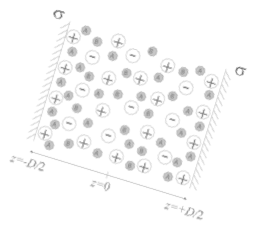
The forces between charged macromolecules, usually given in terms of osmotic pressure, are highly affected by the intervening ionic solution. While in most theoretical studies the solution is treated as a homogeneous structureless dielectric medium, recent experimental studies concluded that, for a bathing solution composed of two solvents (binary mixture), the osmotic pressure between charged macromolecules is affected by the binary solvent composition. By adding local solvent composition terms to the free energy, we obtain a general expression for the osmotic pressure, in planar geometry and within the mean-field framework. The added effect is due to the permeability inhomogeneity and nonelectrostatic short-range interactions between the ions and solvents (preferential solvation).         

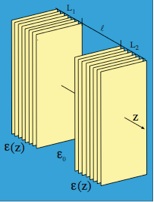
We study the thermal Casimir effect between two thick slabs composed of plane-parallel layers of random

dielectric materials interacting across an intervening homogeneous dielectric. It is found that the effective

interaction at long distances is self-averaging and is given by a description in terms of effective dielectric

functions. The behavior at short distances becomes random - sample dependent- and is dominated by the local  values of the dielectric function proximal to each other across the dielectrically homogeneous slab.

MORERESEARCH6.htmlRESEARCH6.htmlshapeimage_5_link_0

Long Range Interactions in Nanoscale Science


We review our understanding of the “long-range” electrodynamic, electrostatic, and polar interactions that dominate the organization of small objects at separations beyond an interatomic bond length. From this basic-forces perspective, we describe a large number of systems from which we can learn about these organizing forces and how to modulate them. We then survey the many practical systems that harness these nanoscale forces. Our survey reveals not only the promise of new devices and materials, but also the possibility of designing them more effectively.

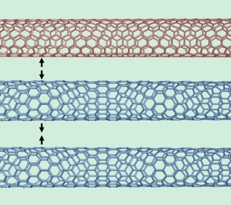
Forces that reach beyond the length of an interatomic bond dominate the organization of matter at the scale of nanometers. This review describes long range electrodynamic, electrostatic, and polar interactions.  The basic physics is illustrated with instructive

examples drawn from a diverse array of topics, including carbon nanotubes, DNA, interfaces and surfaces, and suspensions. The review concludes with a survey of how long range interactions at the

nanoscale can be manipulated for practical use.