More research highlights

Institut "Jožef Stefan", Jamova 39, 1000 Ljubljana, Slovenija, Telefon: (01) 477 39 00, Faks.: (01) 251 93 85
info@ijs.si



Thermodynamics of nanospheres encapsulated in virus capsids. We investigate the thermodynamics of complexation of functionalized charged nanospheres with viral pro- teins. 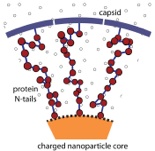 The physics of this problem is governed not only by electrostatic interaction between the proteins and the nanosphere cores (screened by salt ions), but also by configurational degrees of freedom of the charged protein N tails. We approach the problem by constructing an appropriate complexation free-energy functional. On the basis of both numerical and analytical studies of this functional we construct the phase diagram for the assembly which contains the information on the assembled structures that appear in the thermodynamical equilibrium, depending on the size and surface charge density of the nanosphere cores. We show that both the nanosphere core charge and its radius determine the size of the capsid that forms around the core. Protein-DNA interactions determine the shapes of DNA toroids condensed in virus capsids.
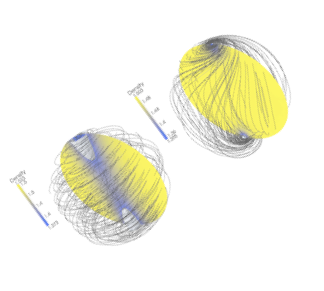
Confined nematic polymers: Order and packing in a nematic drop. We investigate the tight packing of nematic polymers inside a confining hard sphere. We model the polymer via the continuum Frank elastic free energy augmented by a simple density dependent part as well as by taking proper care of the connectivity of the polymer chains when compared with simple nematics. The free energy ansatz is capable of describing an orientational ordering transition within the sample between an isotropic polymer solution and a polymer nematic phase. We solve the Euler-Lagrange equations numerically with the appropriate boundary conditions for the director and density field and investigate the orientation and density profile within a sphere. Two important parameters of the solution are the exact locations of the beginning and the end of the polymer chain. Pending on their spatial distribution and the actual size of the hard sphere enclosure we can get a plethora of various configurations of the chain exhibiting different defect geometry.

Protein-DNA interactions determine the shapes of DNA toroids condensed in virus capsids. DNA toroids formed inside the bacteriophage capsid present different shapes according to whether 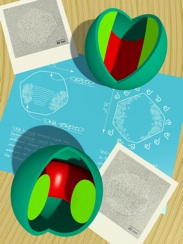 they are formed by addition of spermine or PEG to the bathing solution. Spermine-DNA toroids present a convex facetted section with no or minor distortions of the DNA interstrand spacing with respect to those observed in the bulk, whereas PEG-induced toroids are flattened to the capsid inner surface and show a crescent-like, non-convex shape. By modelling the energetics of the DNA toroid using a free energy functional composed of energy contributions related to the elasticity of the wound DNA, exposed surface DNA energy and adhesion between the DNA and the capsid, we established that the crescent-shape of the toroidal DNA section comes from attractive DNA interactions between DNA and the capsid.
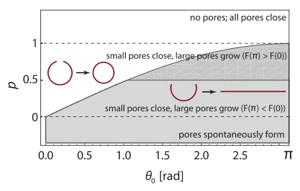
Electrostatic self-energy of a partially formed spherical shell in salt solution: Application to stability of tethered and fluid shells as models for viruses and vesicles. We investigate the electrostatics of a partially formed, charged spherical shell in a salt solution. We solve the problem numerically at the Poisson-Boltzmann level and analytically in the Debye-Hu ̈ckel regime. From the results on energetics of partially formed shells we examine the stability of tethered (crystalline) and fluid shells toward rupture. We delineate different regimes of stability, where, for fluid shells, we also include the effects of bending elasticity of the shells. Our analysis shows how charging of the shell induces its instability toward rupture but also provides insight regarding growth of charged shells.

