More research highlights

Institut "Jožef Stefan", Jamova 39, 1000 Ljubljana, Slovenija, Telefon: (01) 477 39 00, Faks.: (01) 251 93 85
info@ijs.si



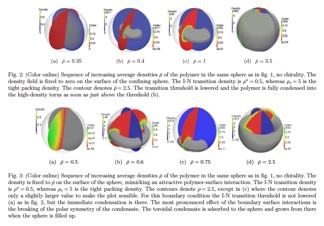
We investigate condensation of a long confined chiral nematic polymer inside a spherical enclosure, mimicking condensation of DNA inside a viral capsid. The Landau-de Gennes nematic free-energy Ansatz appropriate for nematic polymers allows us to study the condensation process in detail with different boundary conditions at the enclosing wall that simulate repulsive and attractive polymer-surface interactions. By increasing the chirality, we observe a transformation of the toroidal condensate into a closed surface with an increasing genus.
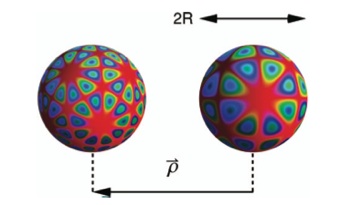
Inhomogeneous charge distributions have important repercussions on electrostatic interactions in systems of charged particles but are often difficult to examine theoretically. We investigate how elec trostatic interactions are influenced by patchy charge distributions exhibiting certain point group symmetries. We derive a general form of the electrostatic interaction energy of two permeable, ar- bitrarily charged spherical shells in the Debye-Hückel approximation and apply it to the case of particles with icosahedral, octahedral, and tetrahedral inhomogeneous charge distributions.
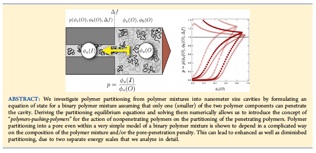
We investigate polymer partitioning from polymer mixtures into nanometer size cavities by formulating an equation of state for a binary polymer mixture assuming that only one (smaller) of the two polymer components can penetrate the cavity. Deriving the partitioning equilibrium equations and solving them numerically allows us to introduce the concept of “polymers-pushing-polymers” for the action of nonpenetrating polymers on the partitioning of the penetrating polymers. Polymer partitioning into a pore even within a very simple model of a binary polymer mixture is shown to depend in a complicated way on the composition of the polymer mixture and/or the pore-penetration penalty.
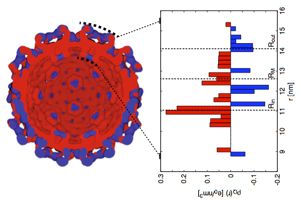
We investigate and quantify salient features of the charge distributions on viral capsids. Our analysis combines the experimentally determined capsid geometry with simple models for ionization of amino acids, thus yielding a detailed description of spatial distribution for positive and negative charges across the capsid wall. The obtained data is processed in order to extract the mean radii of distributions, surface charge densities, as well as dipole moment densities. The results are evaluated and examined in light of previously proposed models of capsid charge distributions, which are shown to have to some extent limited value when applied to real viruses.