More research highlights

Institut "Jožef Stefan", Jamova 39, 1000 Ljubljana, Slovenija, Telefon: (01) 477 39 00, Faks.: (01) 251 93 85
info@ijs.si



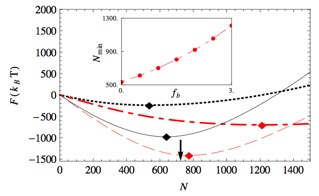
RNA encapsulation free energy as a function of monomer numbers for a linear polymer with fb=0 (solid and dotted lines) and a branched polymer with fb=3 (dashed and dot- dashed lines) at two different values of μ, corresponding to salt concentrations 10 mM (solid and dashed lines) and 100 mM (dotted and dotted-dashed lines). Inset shows the position of the minimum Nmin vs. the branching fugacity fb for 100 mM salt concentration. Other parameters used are υ = 0.5, τ = −1, σ = 0.4, b = 12, and T = 300K, typical for RNA and virus capsids.
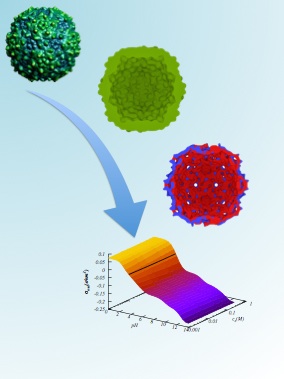
We investigate and quantify the effects of pH and salt concentration on the charge regulation of the bacteriophage PP7 capsid. These effects are found to be extremely important and substantial, introducing qualitative changes in the charge state of the capsid such as a transition from net- positive to net-negative charge depending on the solution pH. The overall charge of the virus capsid arises as a consequence of a complicated balance between the chemical dissociation equilibrium of the amino acids, the electrostatic interaction between them and translational entropy of the mobile solution ions, i.e., counter ion release. We show that in order to properly describe and predict the charging equilibrium of viral capsids in general, one needs to include molecular details as exemplified by the acid-base equilibrium of the detailed distribution of amino acids in the proteinaceous capsid shell.
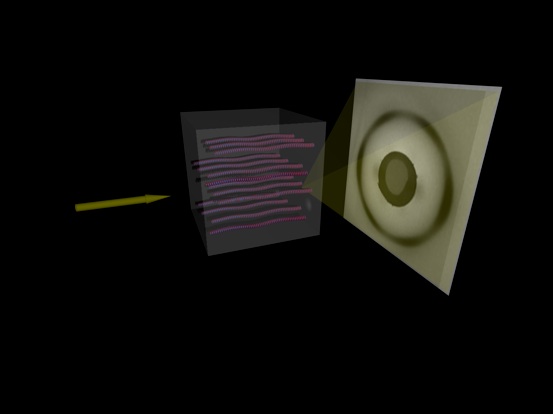
A new method of finely temperature-tuning osmotic pressure allows identification of the cholesteric → line hexatic transition in monova- lent salt long-fragment DNA solutions as first order, with a small but finite volume discontinuity. This transition is therefore quite similar to the osmotic pressure-induced expanded → condensed DNA tran- sition at subcritical polyvalent salt concentrations, with a continuity of states between the two. This finding, together with the corre- sponding empirical equation of state, effectively relates the phase diagram of DNA for monovalent salts to that for polyvalent salts and sheds some light on the complicated interactions acting between DNA molecules at high densities.
